
 Facebook
 X
X
 Pinterest
 Copy Link
Answer:
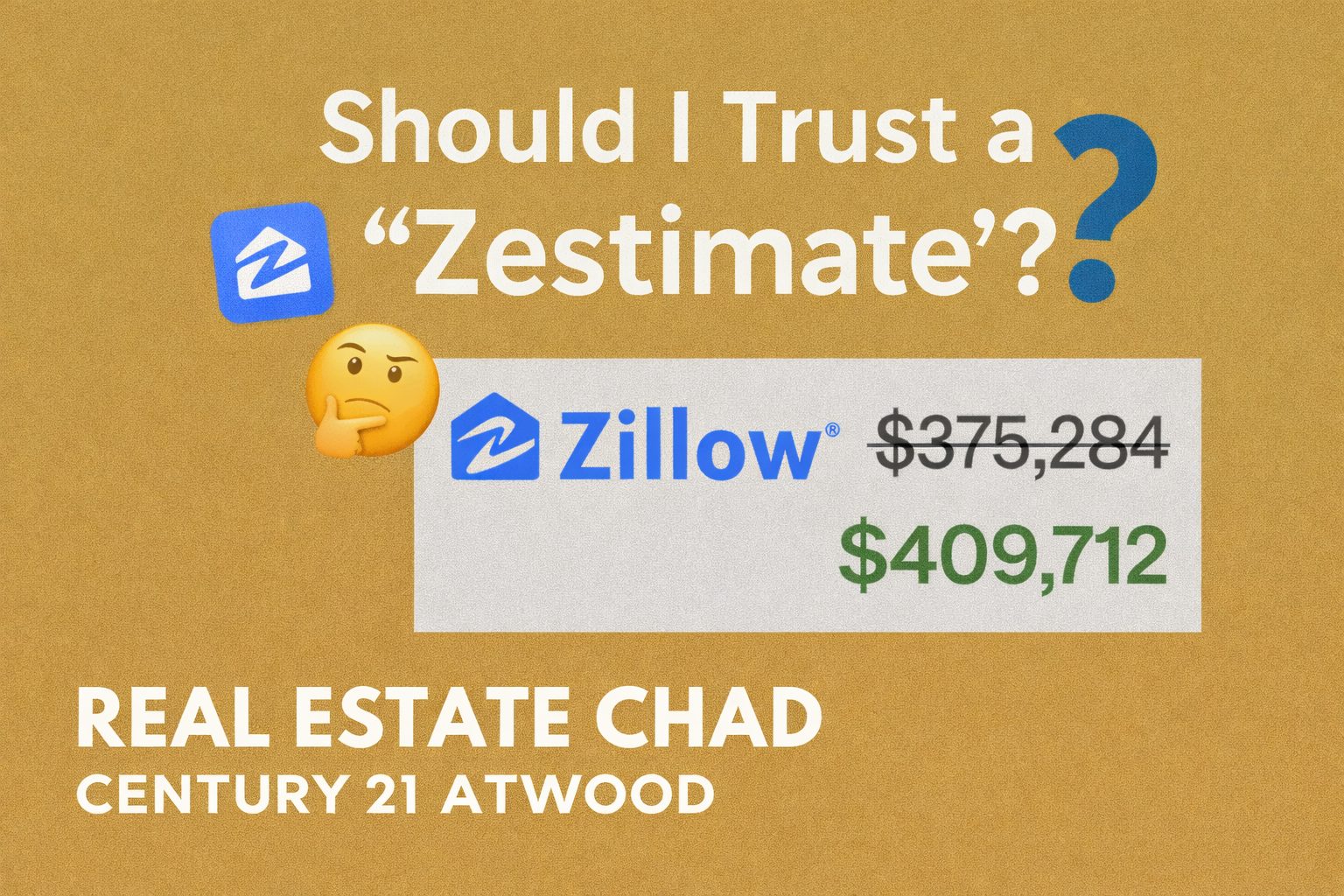
You’re scrolling Zillow, you see a dollar figure next to a home or worse, your home! — the infamous Zestimate® — and you think, “Is that what my house is really worth?” 🤔 It’s a common question! Chad Ziemke here with Century 21 Atwood, I want to help you separate tech hype from real market value.
Zillow’s Zestimate is an automated estimate of a home’s value based on algorithms that pull from public records, recent sales, tax data, and user-submitted information. For many people, it’s a convenient starting point when dreaming about their next home or trying to guess what their current home might be worth. See my Blog about – What is my home really worth?
But here’s the reality: Zestimates are not appraisals — and they’re often off by a meaningful amount. Zillow itself reports that its nationwide median error rate is about 1.9–2.4% for homes currently on the market and over 7% for off-market homes — meaning the Zestimate can be tens of thousands of dollars higher or lower than the actual selling price.
That sounds pretty accurate at face value, but ask yourself:
⚠️ What if your home’s Zestimate is too high — and you overprice it?
⚠️ Or too low — and you leave money on the table?
And remember: Zestimate algorithms don’t physically inspect your house. They don’t know you replaced the roof last year, updated the kitchen, added a finished basement, or made other improvements that bring real value to buyers.
🧠 Why Zestimates Can Mislead
-
Data gaps: If public records are outdated or missing key details, the Zestimate starts on shaky ground.
-
Unique homes: Custom features, renovations, and neighborhood quirks don’t show up as clearly in a database.
-
Local nuance: Real estate is hyperlocal — factors like nearby school ratings, buyer demand, and neighborhood trends can dramatically affect value. Algorithms can’t interpret that like a seasoned local agent can.
📊 What Zillow’s Own Data Shows
According to Zillow and third-party research:
-
Roughly half of Zestimates are outside Zillow’s own reported median error range.
-
For homes that aren’t listed for sale, errors are much larger — sometimes 7% or more off.
-
Some localized studies have found even greater discrepancies when homes are custom, unique, or in areas with fewer recent sales.
In short, while Zestimates are great for a quick ballpark, they’re not reliable enough for pricing your home or making major decisions.
⭐ What You Should Do Instead
If you want an accurate understanding of your home’s value — not a computer guess — you need someone with boots-on-the-ground.
👉 A Competitive Market Analysis (CMA) uses real recent sales of similar homes in your exact neighborhood, adjusted for condition, upgrades, and features.
👉 A Professional Realtor (That’s Me!) not only analyzes data — I walk homes, understand buyer preferences right now in Southern Minnesota, and interpret the market like a local insider.
Whether you’re thinking of selling, refinancing, or just curious, I’d be happy to provide a free, no-pressure home valuation that’s grounded in real market facts — not an algorithm.
📞 Call or Text Chad Ziemke – Real Estate Chad with Century 21 Atwood — because your home deserves more than a guess. 💛🏡 Hear from my clients!


